Quick Tip #16

For us outdoorsmen and outdoorswomen colder weather brings more gear to be carried and extra challenges that we gladly face. One thing that is made easier with the colder weather is food preservation. With colder temperatures you can now carry raw meat (properly packaged), cooked meat as well as other foods you would not normally carry during the warmer months. So have fun with the colder weather and carry a nice steak out into the middle of nowhere, with a beautiful view, and cook that steak and fully enjoy some of the benefits of the colder temperatures this time of year. What foods do you take out during the colder months that you wouldn’t normally carry when it’s warmer?

UST Orange Survival Bandana

I’m not one for promoting deals I’m running on my website here on my blog but I thought the current deal was worth mentioning. Now through December, with every purchase of $25 or more, you will receive a UST orange survival bandana. These are no ordinary bandanas. Printed on them are many survival tips that can be very useful in the event of a survival situation. These would be great for kids or adults that are lacking in survival/camping knowledge. There’s the obvious many extremely useful ways to use a bandana but now you would also have many survival tips that you wouldn’t necessarily have to remember or have to call back to memory in a survival scenario. This is just a great way to take something you may already be carrying and make it even more useful. Also, all orders in the continental U.S. will receive free standard shipping through December. Just click on the store button and place an order of $25 or over to receive your free bandana and free standard shipping. Hope everyone is doing well and getting the chance to enjoy the great outdoors.

survival-bandana

Inexpensive Quality Knives

You don’t have to spend a ton of money for a decent bushcraft or survival knife. Now I do agree in most cases that you get what you pay for but there are some exceptions to the rule. I own some expensive knives but this year I have mostly just carried my Mora companion, with attached fire kit, and an Esee Avispa folder. Both of which are fairly inexpensive, not overly heavy but are very well made knives. I also usually take a small hatchet for cutting up firewood so I’m not using my knife to baton wood (I just prefer to save my knives from this abuse if I can).

Mora makes great quality products that can take abuse but at an expense that you wont mind if you loose or damage it. I have added a fire kit to the outside of mine. The fire kit consists of a ferocerium rod, 1 piece of quik tinder (burns for 2 minutes) and is attacked with a 1 1/2″ ranger band. The Mora knife I carry is made of high carbon steel. This is a great quality for bushcraft or survival but also means the knife blade needs more care and cleaning. It is highly worth it in my mind.

The Esee Avispa is a great addition to the Mora. I carry a pocket knife on me daily because I find I use it and need it a lot. So it’s only natural for me to be carrying a folder. The blade on the Avispa is made of Aus-8 stainless steel. I like to have a stainless steel folding knife as a companion to any high carbon steel fixed blade I would be carrying because it saves me from pulling out my fixed blade knife every time I need to cut something and the stainless blade needs less care and upkeep than the high carbon steel blade needs. Also I like the fact that if I loose one knife I’ll still have one available to me instead of loosing my only knife and having nothing else to use.

These two knives together weigh less than one more expensive bushcraft or survival knife by themselves. For about $50-$70 you could have a great set up for your wilderness adventures. Before anyone complains, what about this knife or that knife, I know there are many great and expensive bushcraft and survival knives out there as well as better folders but these just happen to be what I’m carrying a lot these days and I think this is a great setup for those that can’t afford much or don’t want to spend a lot on one or two knives. These are fairly inexpensive knives but are better quality than their price portrays.

I hope this was helpful to some and an encouragement that you don’t need to spend a ton of money on gear to go out and enjoy the wilderness. Feel free to let me know what your favorite knife or knives are to carry on your wilderness adventures. As always get out there and enjoy the wilderness and maybe even relax and unwind a bit.

Quick Tip #14

You know that shiny emergency blanket you have tucked away in your backpack or emergency kit? It’s got so many more uses than to be just used simply as an emergency blanket. One use we will be talking about quickly today is as a heat reflector near a fire.

Find yourself two fairly straight sticks that are about an inch or so thick and will be about two feet longer than the shorter side of the emergency blanket. Sharpen one end of each stick to a point. Now lay your emergency blanket out on the ground stretched out flat. Take one of your sticks and lay it across the short side of the emergency blanket. Leave about 1 ½ feet of the sharpened end sticking out passed the blanket and about ½ foot on the other end. Start to roll the emergency blanket around the stick about 6 or so times. Now do the same thing on the other side of the emergency blanket with the other stick.

You are now ready to setup a heat reflector by your fire. Choose whether you want the heat reflector across the fire from you or behind you. If you choose to place the heat reflector near the fire across from you, make sure, depending on the size of your fire that the emergency blanket is a reasonable distance away from the fire so that it doesn’t melt or get holes in it from sparks flying around.

Once you have chosen where you want to place the heat reflector find a thick stick or something else that can be used as a hammer. Push the pointed end of each stick into the ground as far as you can well keeping the emergency blanket in between the two sticks as tight as possible. Now hammer the blunt end of each stick, making sure not to hit so hard you break the sticks wrapped in the emergency blanket, so that the pointed end goes further into the ground. Make sure to leave 2-4 inches in between the ground and the emergency blanket so that it is less likely to get damaged. You should now have a nice heat reflector that will help you capture some of the lost heat from your fire. If you set the reflector up behind you it will help remedy the issue of having a cold backside.

As always get out and enjoy nature at your own risk and have fun doing it. Thanks for taking the time to read and feel free to leave a comment or let me know some of the extra ways you use emergency blankets.

Quick Tip #13

When putting together an emergency fishing kit try using braided fishing line instead of mono. If you’ve ever tried to straighten out that emergency fishing line in any of the small kits available on the market today you know it’s a feat in itself to get it untangled and to try to ever get it straight again. Braided fishing line can take being wound up tightly unlike mono line can. Also the braided line is thinner in comparison to the mono for the same pound test line. If you ever need that emergency fishing kit you made you’ll be happy (jumping for joy) that you chose to use braided fishing line over mono. Which fishing line do you prefer, braided or mono, for an emergency fishing kit and why?

Quick Tip #10

Use hydration bags for kids to carry water and food. It will free up their hands for other things like picking berries and exploring. It will also get them use to carrying a bag on their back and slowly introduce them to backpacking over time. I found that with my own kids, they got tired of carrying a water container and the containers were too heavy to clip to their pants. I bought cheap hydration bags from Sam’s Club at the end of the season. I think I ended up only paying $15 per bag. I threw out the plastic bladder bag because it was a cheap plastic and I couldn’t remove the plastic taste and some of them leaked. I prefer to use Stainless bottles anyway. We just place the bottle in the area where the hydration bag would go and place snacks or any other items in the other pouches. There is also a nice little pouch inside of these bags where I place an emergency blanket for each child. That way if something happened where all or any of us got lost and had to spend the night in the wilderness unexpectedly, we would each have some shelter from wind, rain and cold. I like these bags better than other more expensive bags because there is more storage than a standard hydration backpack and they were a lot cheaper. They are a cross between a small hydration pack and a small backpack, perfect for our purposes. Someday I plan on doing a lightweight backpacking trip using one of these packs just to see how well it would work. I’ll let you know how it works out. Have a great time enjoying the wilderness with your kids.

Start Them Young

I have four boys between the ages of 22months and 10. They all love the outdoors. I take the older two hunting with me during early hunting season when it’s a bit warmer. They love to hike and my 10 year old absolutely loves kayaking. They can’t get enough of hiking in the wilderness. This year I started a new tradition where I’m going to be taking each one of my older three boys on their own three day weekend adventure. I plan on doing this every year from now on. They can’t wait. This way we can get some one on one time (hopefully get them more comfortable talking to me and prepare them for their teen years) and I can also tailor each trip to each of my sons’ abilities and likes.

This month I will be taking my older son. We are going to kayak out to an island where we will camp for three days. We will do a lot of fishing. He is a natural when it comes to fishing. He had all kinds of trouble trying to fish with those cheap kids combos so one day I gave him one of my fishing poles and off he went. He could cast it farther than a lot of adults and he’s caught some nice size fish all on his own. The area where we are staying is surrounded by over 2500 acres of state forest which is full of trails and streams. So we will be spending a bit of our time hiking as well. I don’t know who’s more excited him or me.

All of my kids love being outside but my 22 month old can’t get enough. All winter he would just trudge through the snow and didn’t care how much effort it took or even how cold it was. Now that it is nice outside he doesn’t want to be anywhere but outside. He loves to help feed and water the chickens. It amazes me how much he can actually do all on his own! On Mother’s Day after we had dinner the kids and I were out walking around our property. We have a section of our property that has a steep hill in the woods that is mostly loose dirt and tree roots. He was climbing up and down the hill without any help and never fell once. None of our kids could do that so early! This kid has amazing balance. I wish I had a picture of this hill so that you could see it.

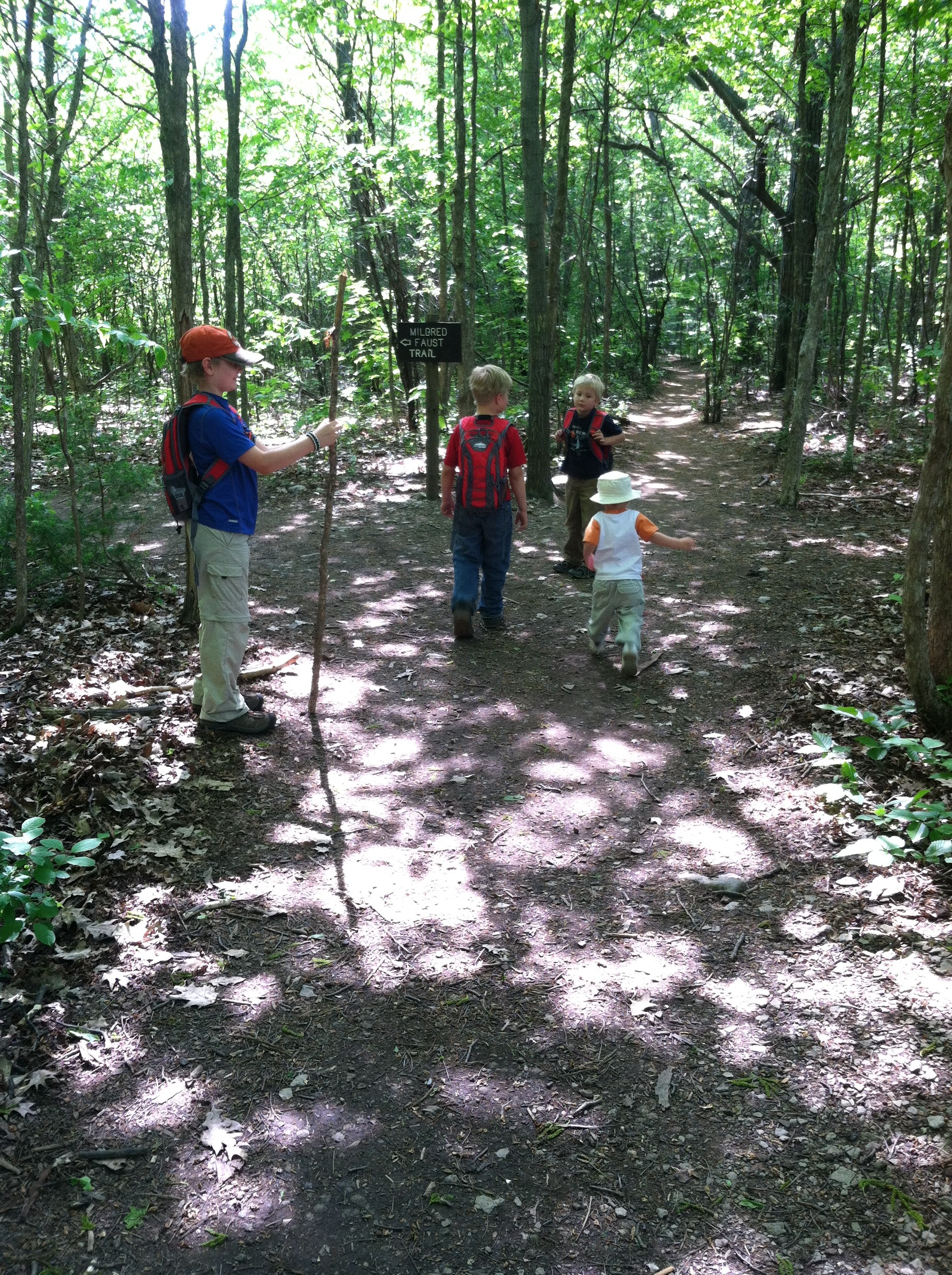
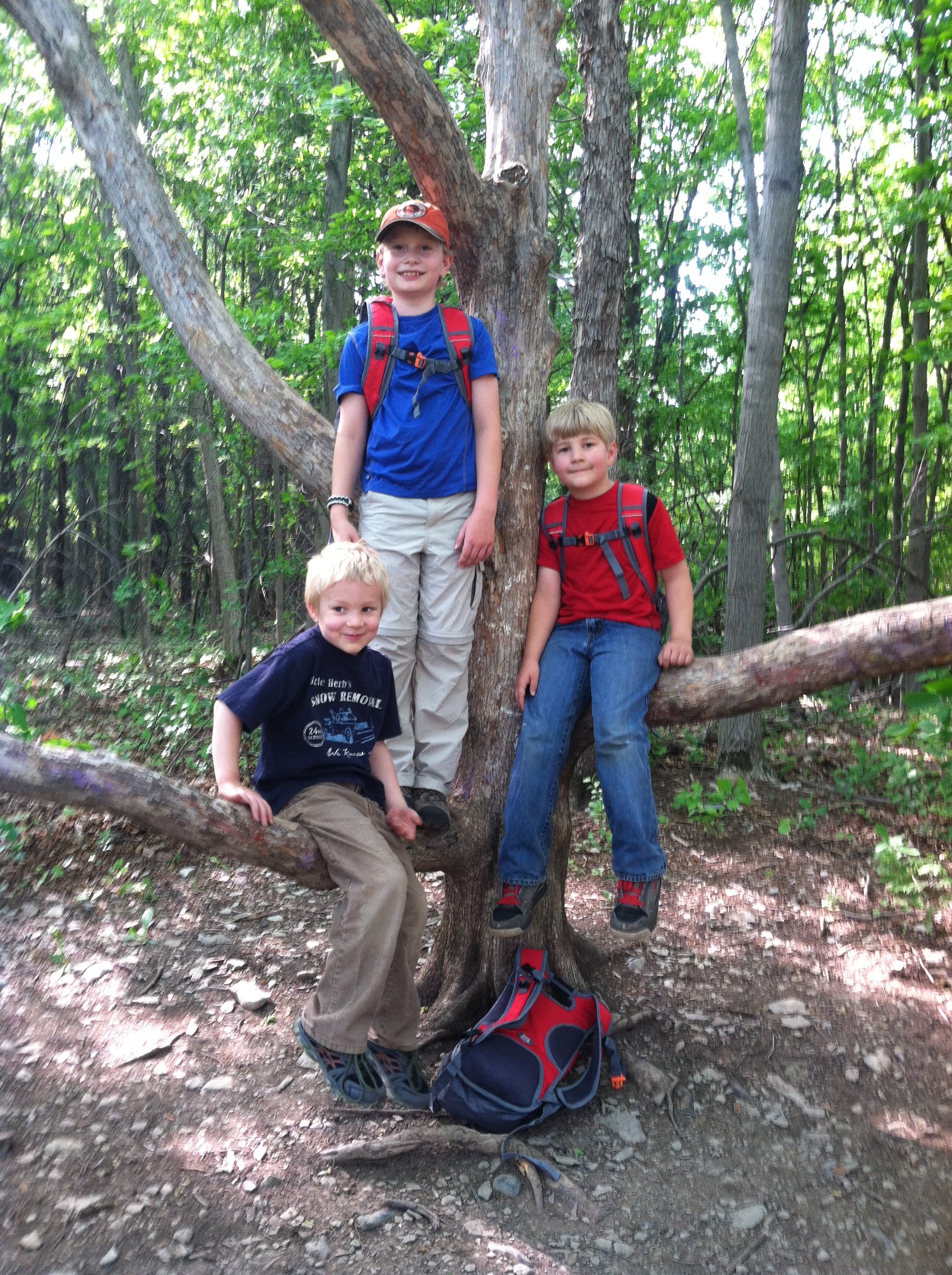
I say all this to encourage people to get their kids out hiking and enjoying outdoor activities as early as possible and to do it as a family. I had my older son sitting in my lap well kayaking before he could even walk (he had a life jacket on and I had a long daisy chain hooked from the top of my lifejacket to the bottom of his). He loved it. Children are much more capable than we think. You’ll never regret the time spent outside with your kids but you’ll always regret the time wasted on TV and video games. They will always cherish those memories as well. I still remember all the camping and fishing trips I took as a kid. Those are the memories I cherish most. Below are some pictures of us hiking on a well worn trail system on Memorial Day. What activities does your family like to do outside together? Do your kids like being outdoors? If your family is not use to hiking or being outdoors regularly, start small. A simple hike down a short trial will do wonders. Don’t try to start out with more than you or they can handle. Start small and enjoy working your way up to more difficult hikes, camping trips or backpacking trips. Enjoy the process together. You’ll also get to see some breathtaking views along the way.

Just an FYI, we have each of the older three kids carry their own hydration bag. This works out very well. They can easily carry their own water, snacks and lunch. We tried having them just carry containers with water in them but not too long down the trail they would get tired of carrying the containers so we found that this works our well for us. Also, with boys you will need snacks. Don’t venture out without some. If they are not eating they are thinking about eating! Our boys eat more than my wife and I do. Anyway, enjoy the time spent outdoors with your kids and don’t underestimate their abilities.


photo 1                                 photo 2

photo 3                                 photo 4

Homemade Mosquito and Tick Repellant

I love the wilderness dearly, but like most I get tired of getting eaten alive. I get bit even when no one else is being bitten! I’m always looking for natural bug repellants because I don’t like spraying pesticides on my body or clothing and especially not on my kids. My wife and I have tried many natural remedies and well some sort of work, none have worked for me. I’m special that way. The other week I came across a recipe for a natural tick and mosquito repellant that seems to work very well. I can’t remember where I got the recipe from or I would give the site credit. Good thing I wrote the recipe down! So I thought that I would share my findings.

Ingredients:

2 Cups of Distilled Vinegar
1 Cup of Water
20 Drops of Essential Oil

 
*Spray on skin, clothing and hair every 4 hours or as needed.

 
By adding essential oils you won’t smell like vinegar all day. We used peppermint essential oil because it is a natural repellant for ticks and mosquitoes. You can choose whatever essential oil that you would like but any type of mint or citrus essential oils would work great since they are natural repellants for ticks and mosquitoes. Mix everything together and place in a spray bottle or multiple pump spray bottles. So far this mixture works well for me and does better than any store bought spray. It is much more comforting to know that what I am spraying on my children and on me is not going to harm them or me. Try this recipe out and let me know how it works for you. What natural bug repellants do you use? How well do they work for you? Thanks for reading and please let me know if this helps you fend off the bugs this year.

Survival Food: Wild Game

Right now in New York we are in the midst of spring Turkey hunting season and walleye fishing season. I absolutely love this time of year. New life is springing forth and the air seems so fresh. The weather is consistently getting nicer and the warmth of the sun feels so wonderful and energizing. I find myself wishing I could spend every waking moment, this time of year, in the wilderness instead of keeping a regular work schedule.

Anyway the reason I’m bringing up the fact that we are in the midst of hunting and fishing season (in New York) is that this is the perfect time to learn skills for gathering wild game or to teach your young children how to catch wild game. When it comes to survival, knowing how to provide food for yourself and anyone with you could mean the difference between life and death.

Since the weather is nicer and generally warmer at this time of year it is easier on younger children to be out hunting now instead of in late fall (not very warm in New York usually by then). Teaching them how to hunt and fish well they are young will give them the time to fine tune their skills and will give them an appreciation for nature. Teach them to hunt or fish with the bare minimum instead of outfitting them with every gadget known to man. This will make them rely on skill instead of technology. Use homemade lures to catch fish. Try fishing with just a stick, some fishing line, a hook and a worm or homemade lure. This can be fun and challenging all at the same time. Adults should be practicing these skills as well. In a real survival situation you will most likely not have any professional fishing or hunting equipment. Now is the time to learn and practice these skills. Not when your life depends on it.

Test your skills when hunting. If you’re a bow hunter, try hunting with a recurve or long bow instead of a compound bow. If you already bow hunt with a recurve or long bow try making your own bow and hunting with that. For gun hunters, try bow hunting or get rid of the scope and use sights. If you have an area where you are able to, you can learn how to trap. No matter how skilled we are at hunting and fishing or trapping, we can all challenge ourselves more and fine tune our skills. The older I get the more I want to hunt or fish with gear that is as basic as possible. Someday if I get the chance I am going to make my own recurve bow and hunt with it.

The point of all this is to say that you need to practice the skill of catching wild game and this is the perfect time of year to do that. If you have children you can get them involved and have fun learning together. They will never forget the time you spend in the wilderness together and these skills may someday save their life or your own. I know many people that live off and provide for their families with the wild game they catch each year. My family included. We only eat wild fish and venison. We raise our own chickens and vegetables. You can save a lot of money by living off the land instead of relying on the grocery store to provide for your family but you need to gain the necessary skills first.

Enjoy this time of year and if you have children let them enjoy it with you. Make sure you obey all hunting and fishing laws in your area and don’t be reckless. Incorporate fishing with your camping trips. This way you’ll have some great tasting free food and your kids will taste the fruit of their labors. There’s nothing more satisfying than providing your own food well out backpacking and camping. Enjoy each moment and continue to learn and teach along the way.


(The picture is of my brother and the turkey he shot last weekend).

Hypothermia

At this time of year as the weather becomes warmer during the day people tend to get careless about staying dry as well as keeping their clothes from getting wet. The warmer weather feels great and it seems warmer than it is because we have become acclimated to the colder temperatures. This can make for a dangerous situation. In many areas during spring there can be huge temperature swings between day and night. You could have temperatures in the 80’s during the day and then they can dip below freezing at night. This could be a deadly combination if you find yourself wet and cold.

WIKIPEDIA Definition and Effects of Hypothermia

 
Hypothermia (from Greek ὑποθερμία) is a condition in which the body’s core temperature drops below that required for normal metabolism and body functions. This is generally considered to be 35.0 °C (95.0 °F). Body temperature is usually maintained near a constant level of 36.5–37.5 °C (97.7–99.5 °F) through biologic homeostasis or thermoregulation. If a person is exposed to cold, and their internal mechanisms cannot replenish the heat that is being lost, the body’s core temperature falls, and characteristic symptoms occur such as shivering and mental confusion.
One of the lowest documented body temperatures from which anyone has recovered was 13.0 °C (55.4 °F) in a near-drowning incident involving a 7-year-old girl in Sweden in December 2010.[1] Hypothermia is the opposite of hyperthermia which is present in heat exhaustion and heat stroke.


Mild

 
Symptoms of mild hypothermia may be vague, with sympathetic nervous system excitation (shivering, hypertension, tachycardia, tachypnea, and vasoconstriction). These are all physiological responses to preserve heat. Cold diuresis, mental confusion, and hepatic dysfunction may also be present. Hyperglycemia may be present, as glucose consumption by cells and insulin secretion both decrease, and tissue sensitivity to insulin may be blunted. Sympathetic activation also releases glucose from the liver. In many cases, however, especially in alcoholic patients, hypoglycemia appears to be a more common presentation. Hypoglycemia is also found in many hypothermic patients, because hypothermia may be a result of hypoglycemia.


Moderate

 
Low body temperature results in shivering becoming more violent. Muscle mis-coordination becomes apparent. Movements are slow and labored, accompanied by a stumbling pace and mild confusion, although the person may appear alert. Surface blood vessels contract further as the body focuses its remaining resources on keeping the vital organs warm. The subject becomes pale. Lips, ears, fingers and toes may become blue.


Severe

 
As the temperature decreases, further physiological systems falter and heart rate, respiratory rate, and blood pressure all decrease. This results in an expected heart rate in the 30s at a temperature of 28 °C (82 °F).
Difficulty in speaking, sluggish thinking, and amnesia start to appear; inability to use hands and stumbling is also usually present. Cellular metabolic processes shut down. Below 30 °C (86 °F), the exposed skin becomes blue and puffy, muscle coordination becomes very poor, walking becomes almost impossible, and the person exhibits incoherent/irrational behavior including terminal burrowing (see below) or even a stupor. Pulse and respiration rates decrease significantly, but fast heart rates (ventricular tachycardia, atrial fibrillation) can occur. Major organs fail. Clinical death occurs.


Paradoxical undressing

 
Twenty to fifty percent of hypothermia deaths are associated with paradoxical undressing. This typically occurs during moderate to severe hypothermia, as the person becomes disoriented, confused, and combative. They may begin discarding their clothing, which, in turn, increases the rate of heat loss.

 
Rescuers who are trained in mountain survival techniques are taught to expect this; however, some may assume incorrectly that urban victims of hypothermia have been subjected to a sexual assault.

 
One explanation for the effect is a cold-induced malfunction of the hypothalamus, the part of the brain that regulates body temperature. Another explanation is that the muscles contracting peripheral blood vessels become exhausted (known as a loss of vasomotor tone) and relax, leading to a sudden surge of blood (and heat) to the extremities, fooling the person into feeling overheated.


Terminal burrowing

 
An apparent self-protective behavior known as terminal burrowing, or hide-and-die syndrome, occurs in the final stages of hypothermia. The afflicted will enter small, enclosed spaces, such as underneath beds or behind wardrobes. It is often associated with paradoxical undressing. Researchers in Germany claim this is “obviously an autonomous process of the brain stem, which is triggered in the final state of hypothermia and produces a primitive and burrowing-like behavior of protection, as seen in hibernating animals.”This happens mostly in cases where temperature drops slowly.


It is important to dress in layers just like you would during the winter months. As you become warm remove a layer at a time until you are not perspiring. Try to keep your clothing as dry as possible. If you find yourself crossing a river or stream, try to cross at a shallow point or carry clothing across if possible. If clothing becomes wet either because of the environment or because of perspiration, try to get the wet clothing dry before dark when temperatures start to drop. Dry clothes over a fire or try to get them dry by laying them on large warm rocks in the sunlight of the day. Whatever you must do to get dry and warm before dark do it.

 
It is important to carry rain gear and a good waterproof shelter at this time of year as well. A day of hiking in a cold drenching rain can sap you of energy and drop your core temperature quickly once you stop moving. The last thing you want to do is to have a poor shelter that is not waterproof and find yourself in a freezing rain storm in the middle of the night. It’s all about being smart and preparing ahead of time. Be prepared for the changes of temperature and weather that go along with this time of year. The better you are prepared, the better the chance that you will enjoy your trip and return safely. Be wise about the clothing you are wearing and the materials they are made out of. Know and learn the limitations of all your gear. Enjoy your spring hiking and camping! Take in the fresh air and new life that is coming forth. This is such a wonderful time of year to be out on the trail enjoying nature. What special gear is a must have for you at this time of year? What special trip do you have planned for this spring? (Please share photos of your trip)