My Lightweight Fishing Kit

I like to be able to go fishing whenever it is at all possible while I’m out hiking/backpacking or anytime as a matter of fact. There is nothing better than freshly caught fish cooked over a fire well out in the wilderness. It is very satisfying! I tend to like to scale things down as much as possible and not carry all kinds of needless weight. My fishing kit is no exception. I wanted to put together as small and light a kit as possible without losing a lot of functionality. So I scoured the internet and stores for products that would help in this endeavor and boy are there a lot of great products out there these days to help put together a small fishing kit.

First off, I was not going to restrict myself to a small emergency fishing kit where I had to tie fishing line on a stick. Well those are great for emergencies (I do carry one on me almost always) I couldn’t see myself pulling the kit out to use every time I got a chance to do some fishing. So I definitely wanted a real usable fishing rod and reel. Well after much time and effort looking around I found the perfect rod and reel combo for my kit.

I stumbled upon the pen fishing rod and boy did I want one. I read a lot of reviews before I bought one but sure enough after all the reading was done I bought my very own pen fishing rod goliath with front drag reel. Here is the link for the one I bought: http://penfishingrods.com/shop/product_details.php?category_id=13&item_id=165

Here is the link for the main page:

http://penfishingrods.com/shop/index.php

These Rod and reels are made very well and they are very easy to cast. You do have to learn to be more careful about how you cast and catch fish. It’s an easy learning process. The big thing is not to use the rod to pull fish out of the water. Always reach down with your free hand and pick the fish up out of the water no matter how small the fish may be. This will save a lot of wear and tear on the rod and save you money from having to replace a broken rod. I chose the front drag reel because that is generally what I always fish with. They do make a bait casting reel and a fly rod and reel combo as well. At some point in the near future I’ll be getting my hands on and testing one of the fly combos. I love the idea of a small fly fishing setup.

As far as the rest of my kit, it contains a small Plano tackle box that is 1”x3”x4 ¾ “. I generally carry a bunch of different types of small spinners, different size hooks, some weights and some swivels. I adjust what is in the tackle box according to the time of year and where I’m going to be possibly fishing. You must also check all local fishing laws for the area you’ll be fishing in. Please save yourself some trouble and follow all fishing laws. It’s not worth ruining a beautiful day fishing because you are using the wrong lures or in an area where you shouldn’t be fishing.

I keep the rod, reel and tackle box in a small ditty bag. The whole kit, bag and all, only weights 11.6 oz. I can definitely legitimize carrying that on any backpacking trip. Having this kit can also supply some extra meals for me as well, which only adds to it being worth carrying. I know there are other small fishing pole companies out there and their products may be great but this is the one I chose and I love it. You can carry a kit like this anywhere you go or leave it in the glove box for that last minute fishing adventure. This is also a perfect fishing kit for a bug out bag. I hope this was a help and gives you some ideas about how to put together your very own lightweight fishing kit. Let me know what you put in your kits and please feel free to ask me any questions you may have. One final thought, keep it simple. Spring is coming so get your fishing kit ready.
RIBZ Wear Front Pack Review

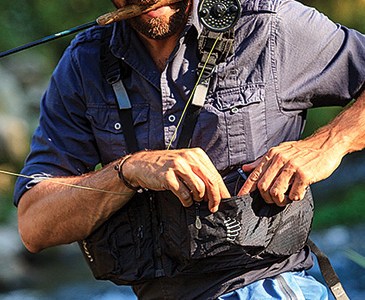
Let me start off by saying that this pack is very versatile. I am so glad that I found the RIBZ Wear pack. They are made of ripstop nylon, which makes them much stronger and more resistant to damage. They are water resistant as well. There is a ton of room in the front pockets of these packs. I use mine for backpacking, camping, fishing, hunting and kayaking. I can’t stress enough how versatile they are. You can use these packs for many things. They would work well for shopping open markets or to wear at fairs so that if you have kids they can still ride on your back and you can store stuff you may need where it is easy to get to. I like to wear mine well carrying my 1 ½ year old on my back well hiking. The RIBZ pack also works well in Bug Out Bag system.

I use the RIBZ pack in conjunction with an EMS lightweight day pack when backpacking. This works very well. I am able to keep my lightweight fishing kit, food for the day, cooking stove (small pocket stove) and any other things I want throughout the day in the front pockets of the pack for easy access. All that is in my backpack now is my sleeping bag, shelter, food and any extra clothing I might have. It spreads the weight more evenly over your body but also saves you from having to stop and take your backpack off every time you want or need something. The RIBZ pack is a time saver and a back pain saver.

The packs are very well made and are easy to adjust as well. Here is the company’s information and specs for the front pack as well as warranty.


The RIBZ front pack is made of 210d water resistant ripstop nylon. The ribs pack weighs approx. 11 oz. All components are water resistant and have proven durability in the most extreme of conditions. With an average storage capacity between 500 and 700 cubic inches, you can comfortably relocate your desired weight in the front packs. The use of a front pack repositions a portion of your weight forward which reduces your overall shoulder stress and increases comfort, mobility, and balance. A front pack also creates the illusion of carrying a lighter load. Though the RIBZ front pack was designed with ultralight backpacking intentions, any outdoor activity where easy access of equipment is critical is where it proves beneficial. RIBZ front pack can be used alone as a vest but is primarily designed to work with your existing backpack as increased functionality.

Fabric:

Cordura Brand water resistant ripstop

Capacity:

700+ Cu In

Weight:

11 oz.

Waist:

32-44 in


Hints and Tips

The RIBZ front pack was designed with many sports and activities in mind. Upon receipt of your RIBZ it is smart to first adjust the shoulder straps so they fit high above the waist line and low enough to fit comfortable under your arms. It will basically be fitted right around your ribcage. It is also a good idea to load your pack with the items for your activity before adjusting the back straps to desired fitting. RIBZ can be adjusted to fit snug for high intensity activities or loosely for when casual. For the serious ultralight backpacking enthusiast, try moving a few pounds off your back into your RIBZ for better weight distribution and comfort. For best results cleaning your RIBZ we recommend hand washing and air drying. RIBZ are capable of being machine washed on gentle cycle though this approach is not favored.


Warranty

RIBZ guarantee all products we manufacture to be free from any defects in material or craftsmanship for a period of one year from the date of purchase. Our warranty is limited to the original purchaser of the product and is not transferable. During the one year warrantee period, RIBZ will either repair or replace, at its option, only the defective part of the pack. RIBZ will not repair or replace any pack that has been torn as a result of accidents or misuse.


I highly recommend this pack if you are an avid outdoorsman or outdoorswomen. Once you use your RIBZ pack you’ll never leave it home and you won’t know how you ever got along without it. I use mine all the time and I’m sure you will to.  I hope this review helps in some way. If you have been hesitant about buying one, you won’t regret the money you spent on this product. If you are not familiar with RIBZ Wear go check out their site.  www.RIBZWear.com  Let me know what you end up using your RIBZ pack for and how much you like it.

Quick Tip #2

A straw can be used for so much more than just a straw. You want to use a brand new unused straw. Crimp one end of the straw and melt it with a lighter.  Now either fill the straw full of antibiotic ointment, a cotton ball soaked in either Vaseline or antibiotic ointment, an emergency fishing kit, a sewing kit, spices or anything else you can think of. Now just crimp the other end where you want the straw cut, then cut and melt it. To make the kit reusable, just cut the second end of the piece of straw extra long and fold it over. Cut another piece of the straw and slide it over the folded end. Having it reusable is perfect for spices. You can make these as small or as large as you want and they will fit in any size survival kit.

Ripstop Nylon

Ripstop nylon is an awesome material. It does have some limitations though. It will melt if it comes in contact with flames, sparks or intense heat. Sunlight (UV) will over time wear on the fabric. Even with these limitations ripstop nylon is well worth looking at using for your many needs as an avid outdoors person. There are many different types of nylon fabric for sale. You can buy plain nylon fabric but it will be more susceptible to tares and holes. I prefer ripstop because if the fabric gets a hole or slight tare in it the ripstop sewing pattern helps to limit the hole or tare from getting bigger. That is a huge advantage.

There are many different weights available as well. I generally like to use 1.1 or 1.3 oz ripstop nylon for my projects. You can get ripstop nylon that is uncoated, coated with silicone, silicone impregnated or urethane coated. I like to buy the uncoated ripstop nylon and spray it with a waterproofer myself when I’m done. If you use the uncoated ripstop nylon it’s easier to find in your local fabric store.  For making a tarp for camping I would recommend using either one of the silicon coated ripstop nylons. I’m not sure how the uncoated nylon with waterproofer sprayed on it will hold up to an all out down poor. I have used the uncoated for tarps but have yet to be out in a down poor. Feel free to test it out though. Here is a site where you can buy any materials you might need for your project, if you are not able to find what you need in your local fabric store.

http://www.bearpawwd.com/fabrics_misc/fabrics_misc.html#rip1

They have a lot of good information on their site and if you don’t want to make something yourself you can just buy one of their products. I am in no way affiliated with the website and do not receive any money for recommending them. I have just found them very useful over the years. You will need small sharp needles for your sewing machine and Gutermann polyester thread works the best. I like to use “hot scissors” or a soldering iron to cut the fabric. This way your edges are sealed as you cut them. I cut on top of a piece of glass for safety purposes. I also like to use shock cord or 550 cord for my projects.

Here are some ideas for what you can make out of ripstop nylon. This list is by no means complete. It is just a list to get you started thinking about what piece of gear you could make instead of buying.

Ditty Bags (easiest thing to start with)              Lightweight Backpack or Day pack

Tarp                                                                 Sleeping Bag Cover

Tent                                                                  Hammock

Lightweight Shirt                                               Pants

Sleeping Bag (with added insulation)                Gaiters

Jackets (add insulation)                                     Backpack Cover


As you can see this is just a small list to get you started on your way to making some of your own gear. If you are not familiar with sewing I’m sure that there are plenty of YouTube videos out there that can show you how to use a sewing machine. Do your research first and learn how to use the sewing machine you have. If you don’t have a machine, check garage sales for a used one, craigslist or ask anybody you know if they have one you can borrow or buy. Many people have one but don’t use them, so you might be able to get a free machine or at least borrow one. If you want to buy a new one and have the money don’t let me stop you, but research the machines first and ask questions about the machine you are about to buy. Let the sales people know what you are planning on using it for.

Enjoy the journey to making your own gear and good luck! Always remember that it doesn’t have to look perfect, and it won’t at first, but you will get better with practice and time. As long as whatever you make is functional and works the way you want it to, who cares if it’s not perfect. It will have character and you’ll have a sense of accomplishment. Feel free to ask me any questions you might have and have fun. What gear do you intend on making over the next year?

Trail Recipes: Breakfast

These are the two main breakfast recipes I use when backpacking. My go to breakfast of choice is a mix of granola, powdered milk and dehydrated fruit. I place enough powdered milk to make 12 oz of milk, into a Ziploc bag. Then I add 1 ½ cups of granola on top of the powdered milk. Lastly I add in 1/4 -1/2 cup of any type of dehydrated or dried fruit that I like. Blueberries, mango and pineapple are some of my favorites. Just add cold water (dependant on the amount of powdered milk you use) and your good to go. Here is the granola recipe my wife uses:

6    c rolled oats

1/2 c maple syrup

1/2 c honey

1/3 c oil (coconut is good)

4    Tbsp butter, melted

1    Tbsp vanilla extract

8    oz nuts, chopped

1    c pumpkin OR sunflower seeds

1/2 c wheat germ

1/2 c flax OR sesame seeds

Cinnamon, to taste

Mix oats, nuts, wheat germ, seeds, and cinnamon in a large bowl. Combine wet ingredients (if using coconut oil, be sure to melt it with the butter) in a small bowl and mix thoroughly. Add wet ingredients to dry ingredients and stir until everything is coated. Divide evenly between two cookie sheets. Bake at 250 degrees Fahrenheit for 1 hour, stirring every 15 minutes. Rotate cookie sheets half-way through baking.

Add dried fruit as desired.

*NOTE: My wife often substitutes molasses for the maple syrup, almond extract for the vanilla, or add nutmeg, cloves, or ginger to the cinnamon. This is a very flexible recipe!

My second mainly used breakfast recipe is basically a homemade oatmeal recipe. If I want some powdered milk in it I place it in the Ziploc bag first, usually enough for an 8 oz serving. Then I add two servings worth of old fashioned oats into the baggy. Lastly I add in any dehydrated or dried fruit and any nuts or seeds that I might like. I find that raisins, golden raisins and crasins to be the best. I like to add walnuts and flaxseeds as well. I like to place the fruits and nuts on a piece of saran wrap and wrap them up and then place them in the baggy. That way I can cook the oatmeal and then add the fruit and nut mix in after all the cooking is done. This makes a great breakfast for chilly mornings. I just place the oatmeal and powdered milk in 2 cups of water and cook until done. When cooking is done let it cool a bit and then just add the fruit and nut mix and enjoy. You can add things like cinnamon and sugar or other seasonings as well. I just like to keep it simple. These are just a couple easy homemade recipes I use when backpacking. I hope you find them useful and feel free to change them according to your taste.

Here is a quick tip for when you are sealing your Ziploc bag. When you have all the contents in the baggy zip it closed except the last ¼ inch. Insert a straw and suck the air out of the baggy carefully without sucking any of the ingredients out (this is why you want the powdered milk on the bottom of the baggy). Now pull the straw out well zipping the last bit of the baggy closed. This will make it much easier for packing later. Let me know if you found these recipes helpful and let me know how you may have changed them up for your own taste. What do you do for breakfast when out on the trail?

SOG Powerlock EOD 2.0 V-cutter Review

Let me start out by saying this is the best multi tool that I have ever used. The SOG Powerlock EOD 2.0 with V-cutter far surpassed my expectations. The plier has gearing which makes it much easier to cut thicker gauge wire. If you find yourself needing to cut fencing this is the multi tool you’ll want. Trying to cut wire with other multi tools is beyond a pain and a workout for your hand.

I love that each feature in the handle locks into place when in use. Not all multi tools for sale these days have locking accessories. I also like that the accessories have a cover to keep them securely in the handle until needed. No more having to deal with accessory items wanting to fall out well using the pliers.  I have used just about every accessory on it and they all work great. The knife blade is very sharp. It is half serrated so some people might not like that but I do. The serration comes in very handy at times. The saw works amazingly well. It is a much better design than most saws you find on multi tools. The philips and flat head screwdriver tips are actually usable. I have the ballistic sheath which I really like. It easily clips on a thick leather belt. I’m not sure of the quality of the leather sheath but I have to believe it is made as well as anything else SOG makes.

Here is SOG’s description for the Powerlock EOD 2.0 with V-cutter:

“Using the proven PowerLock chassis, SOG is the only company to apply Compound Leverage™ technology to EOD(Explosive Ordnance Disposal). This makes it a breeze to crimp blasting caps and demolition cord with less hand pressure. Another unique SOG feature is the positioning of the crimper device within the confines of the handle…not in the plier jaw, like all other designs. This serves to minimize collateral damage to the crimper and allows the operator to have full use of the uninterrupted plier surface. Additionally there is no weakening of the pliers that often causes breakage of the plier tips. The crimper produces non-flaring, high pull out strength crimps that meet government fuse well specifications. It is also GSA approved. The multi tool includes the V-Cutter, which can be used to cut seat belts, paracord, fishing line, electrical cable sheathing and much more!”

Here are the specs:

Overall Length 7″ 17.78 cm Closed Length 4.60″ 11.68 cm
Product Weight 9.60 oz 272.16 g Product Type Multi-Tool
Country of Origin Assembled in
the USA
Engravable Yes
Finish Black Oxide Tool Count 22
Lanyard Hole Yes Packaging Unibox – Display Ready
Sheath Included Yes Sheath Color Dark Brown
Sheath Details Ballistic Nylon (Material), Secure Clip (Attachment), Hook & Loop (Closure), Leather (Material), Belt Through Loop (Attachment), Snap (Closure) Blade Steel Type 420
Handle Material 420 Stainless Steel Hardness Rc. 51-53
Lock Blades Yes Lock Tools Yes
1/2 Serrated Blade Yes 1/4″ Drive Yes
3-Sided File Yes Awl Yes
Blasting Cap Crimper Yes Bolt Grip Channel Yes
Bottle Opener Yes Can Opener Yes
Hard Wire Cutter Yes Large Flat Screwdriver Yes
Medium Flat Screwdriver Yes Needle Nose Pliers Yes
Philips Screwdriver Yes Ruler Yes
Small Flat Screwdriver Yes Wire Crimper Yes
Wood Saw Yes

If you are looking for, or in need of a good multi tool then I highly recommend this one. It would be a great addition to your EDC, bug out bag, 72 hour emergency bag, vehicle glove box, tool box or anywhere else you think that a good multi tool would come in handy. I always have mine on me, even when I’m lightweight backpacking. It’s worth its weight. I just leave the sheath at home and stick it in a pocket that snaps. It’s too valuable to lose it because I didn’t have it secured. So go ahead and buy one! You can thank me later. If you already have one, what are your likes or dislikes about this multi tool?

Cheap Healthy Trail Meals

Like most hikers/backpackers I’ve tried using expensive freeze dried food (Mountain House is the best I’ve ever tasted) or cheap prepackaged foods like ramen noodles or some form of pasta and cheese dish. Neither of these are a very healthy option so I decided to make my own prepackaged meals without all the preservatives and without tons of sodium.  If you have a vacuum sealer you can seal each of your meals individually. I usually just put my meals together a few days in advance so I don’t have to bother vacuum sealing each of them. I just place each individual meal in a sandwich size Ziploc bag and then place all the meals in a larger size Ziploc bag. If it’s a longer trip you will have to use a couple larger Ziploc bags. I place all my meals in order so that my next meal is at the top of the larger bag. I also place my prepackaged snacks in with the meals as well. Everything is in order so that I won’t have to unload the larger bag every time I want to eat. I like everything to be in order and this makes it a much quicker process at meal time.

For breakfast I generally fill a small Ziploc bag with homemade granola, fruit that I dehydrated and some powdered milk. That’s it! Just add cold water when you’re ready to eat. It tastes great and you know what’s actually in what you’re eating as well as saving a ton of money making your own dried food. If it’s colder I like to make up a bag with oatmeal and some of my dehydrated fruit. Sometimes I will add a little powdered milk as well. By making your own bag of oatmeal instead of using the prepackaged bags you’ll save a ton of money, be able to give yourself a bigger portion size and be able to add whatever you want, like fruits and nuts.

For lunches and dinners I’ll make either some form of pasta dish, rice dish or soup with rice or pasta in it. That way I’m getting some carbs for energy. I place all the dry ingredients as well as any spices in the bag and seal it up. This way when it comes time to eat all I have to do is add water and heat it up. For meat I either add dehydrated chicken, venison or a pouch of tuna fish. Tuna fish is the one thing I do buy prepackaged. It is easy to carry and they have a lot of flavors available now. I like to have some form of protein at every meal for sustained energy. You can also take homemade bread products that were just made fresh. You would be surprised how long they will last on the trail, if you don’t eat them first. I like to take homemade tortilla shells. They are awesome!  Just add a package of peanut butter and a package of honey or jelly and you’ve got a sandwich.

Obviously nuts and raisins make a great snack but I also like to take homemade granola bars and homemade graham crackers. Once you have homemade graham crackers you’ll never want another prepackaged one again. I also make my own jerky, which is great for snacking on well on the trail and easy to carry as well.

I hope this gets you thinking about having more control over what you’re eating on the trail as well as enjoying what you’re eating. You can actually enjoy your food, well saving money and being imaginative with what you’re eating. What things do you like to eat on the trail?

Quick Tip #1

When using any type of fire starting rod, make sure to place the tip of the rod on or into the tinder that you are trying to start. Then run your striker down the rod, while keeping the rod still, instead of pulling back on the rod. This will keep the hottest sparks close to the tinder and give you a much better chance at getting the tinder lit. Hope this helps and go out and test your fire starting skills. As always do everything in a safe manner and at your own risk.

Fire Starter Tips

Not all of us want to spend our life savings on cool expensive gear, so here are some simple tips for making your own fire starters.

To start with here are some simple ideas for tinder (a very important part in being able to start a fire). Get a few cotton balls and some Vaseline or triple antibiotic ointment.  Thin out the cotton ball and then begin working in some of the ointment. Mix the two together until the cotton ball is coated well. Now just compact it and put it in a baggy or some other container until you’re ready to use it. When you’re ready to use the cotton ball fire starter just fluff it up and either light it with a match, lighter or fire steel. The cotton ball will burn much longer with the ointment on it than without. If you used triple antibiotic ointment then it can double as a first aid item as well. I love multi -purpose items!

Lint from your dryer makes a great fire starter. Even better would be to take the cardboard roll from a roll of toilet paper and stuff it full of dryer lint. Now just tape off both ends of the roll and you’re good to go. You now have a perfect lightweight fire starter log. You could also store a striker and fire steel rod inside the tube with the dryer lint. This would give you a complete fire starting kit that you could just keep in your backpack until you’re ready to use it.

Some other cheap, lightweight and simple items that you could carry are a crayon, chapstick, saw dust, candle and any piece of wax left from used candles. All of these will aid in trying to get a fire started and you can even use the crayon as a small candle. The chapstick can also be used to lubricate zippers.

You can easily make your very own fire steel rod and striker set. Fire steel rods can be purchased on eBay very easily and much cheaper than buying a pre-made kit. Order whatever size fire steel you would like, then either cut a small piece of deer antler, find a small piece of wood or wooden dowel big enough to hold onto and big enough to drill out for the fire steel rod to be glued into. Next, drill halfway into whatever material you are using for the handle using a drill bit that is the same size as your fire steel. A drill press would work easier but I have done it with a simple cordless screw gun. Now test fit the rod into the hole. If it fits perfectly you are set to glue it up. If it is to tight just ream the hole out a little bit. Not too much though. You are all set to glue the two pieces together now. You can use superglue, wood glue, gorilla glue or epoxy. Whatever you have should work fine. Put some adhesive in the hole and some on the rod and then insert the fire steel into the drilled out hole. Let it dry and now you have your very own inexpensive fire steel.

I also like to drill a small hole at the top of the handle so that I can run a 27” piece of 550 Paracord threw the hole and wear it around my neck. I also add a plastic breakaway clasp and a P-51 can opener. That way I have a striker, can opener and small blade.

These are just a few simple ideas when it comes to fire starters. Feel free to try any of these things at your own risk and let me know how you made out. Let me know if you have any questions or any of your own ideas for cheap simple fire starting material. I hope you like some of these ideas and that they get your mind thinking about what other items you may be able to repurpose or even make yourself.

Tyvek

If you are not familiar with Tyvek you need to get your hands on some. Growing up in the construction industry I’ve always had some at my disposal. It was designed and is used today as a vapor barrier for homes. If you drive by a newly constructed home that has not been sided yet, you will most likely see Tyvek wrapped around the outside of the plywood or chipboard. Tyvek is generally white and is stamped with the manufacturers’ logo. You can buy a roll of it at your local hardware store and it will last you a while. Before you go buying some, check with anybody you know that works on a construction site. They may have some they are throwing away that they may gladly give you for free. Contractors throw this stuff away all the time. I highly recommend you get your hands on some.

Tyvek can be used for many things. The nice thing about having a big roll of it is that you can cut it to fit your different or changing needs. One thing I use Tyvek for is a custom size ground cloth. It works perfectly. No more wasting money on expensive or heavy ground cloths that are going to get ruined with use. Tyvek can also be used as a temporary shelter. It does keep water out to an extent but is not completely water proof. I want to test spraying water proofing on it and see how it holds up in a down poor. I will let you know how that goes. Add some grommets and you can make a custom sized tarp. I know of one guy that made a sleeping bag bivy that looked and worked great.

Tyvek is noisy when working with it so if you are making something that you will be using in the woods, and you want it quiet, you will want to wash it first. Just run it through a cold rinse cycle once and then let it air dry. It will be much quieter and nicer to work with. I know of some people that have tried to die it after washing it once but I’m not sure how well that will work.

A Tyvek ground cloth in combination with a lightweight nylon impregnated ripstop tarp make the perfect shelter for your bug out bag or for those that like lightweight backpacking. This option is much cheaper and lighter.  It’s one I use frequently. So go buy yourself a big roll of Tyvek and make as many things as you can come up with. Have fun saving yourself a ton of money well making your own gear. Some ideas of what to make are a ground cloth, a custom size tarp, a sleeping bag bivy, a simple backpack, diddy bags and whatever else you can come up with. Enjoy and have fun. Thanks for reading and let me know what you made or came up with.