Quick Tip #14

You know that shiny emergency blanket you have tucked away in your backpack or emergency kit? It’s got so many more uses than to be just used simply as an emergency blanket. One use we will be talking about quickly today is as a heat reflector near a fire.

Find yourself two fairly straight sticks that are about an inch or so thick and will be about two feet longer than the shorter side of the emergency blanket. Sharpen one end of each stick to a point. Now lay your emergency blanket out on the ground stretched out flat. Take one of your sticks and lay it across the short side of the emergency blanket. Leave about 1 ½ feet of the sharpened end sticking out passed the blanket and about ½ foot on the other end. Start to roll the emergency blanket around the stick about 6 or so times. Now do the same thing on the other side of the emergency blanket with the other stick.

You are now ready to setup a heat reflector by your fire. Choose whether you want the heat reflector across the fire from you or behind you. If you choose to place the heat reflector near the fire across from you, make sure, depending on the size of your fire that the emergency blanket is a reasonable distance away from the fire so that it doesn’t melt or get holes in it from sparks flying around.

Once you have chosen where you want to place the heat reflector find a thick stick or something else that can be used as a hammer. Push the pointed end of each stick into the ground as far as you can well keeping the emergency blanket in between the two sticks as tight as possible. Now hammer the blunt end of each stick, making sure not to hit so hard you break the sticks wrapped in the emergency blanket, so that the pointed end goes further into the ground. Make sure to leave 2-4 inches in between the ground and the emergency blanket so that it is less likely to get damaged. You should now have a nice heat reflector that will help you capture some of the lost heat from your fire. If you set the reflector up behind you it will help remedy the issue of having a cold backside.

As always get out and enjoy nature at your own risk and have fun doing it. Thanks for taking the time to read and feel free to leave a comment or let me know some of the extra ways you use emergency blankets.

Quick Tip #13

When putting together an emergency fishing kit try using braided fishing line instead of mono. If you’ve ever tried to straighten out that emergency fishing line in any of the small kits available on the market today you know it’s a feat in itself to get it untangled and to try to ever get it straight again. Braided fishing line can take being wound up tightly unlike mono line can. Also the braided line is thinner in comparison to the mono for the same pound test line. If you ever need that emergency fishing kit you made you’ll be happy (jumping for joy) that you chose to use braided fishing line over mono. Which fishing line do you prefer, braided or mono, for an emergency fishing kit and why?

G. Fred Asbell Wool Pullover Review

I’ll be honest I was looking at buying the wool boreal pullover that many of you may have seen reviewed on many YouTube videos, but I just didn’t have the money available to spend on it. The boreal pullover looks really nice and looks well made with options that are not on the pullover I purchased but it costs a whole lot more as well. The boreal pullover was well outside my budget.

As I was searching the internet for wool clothing I came across this website, http://www.asbellwool.com I looked at the site and all that is available and narrowed down my choice to a wool pullover in the Timber Ghost color. I really wanted a pullover in the blanket weight but I also liked the Timber Ghost color for everyday use so the color choice won. Note each color comes in different weight wool. The Timber Ghost color comes in extra heavy weight wool (25-28oz).

The Weight Guide:
Light Weight——————9 – 10oz.
Light/Medium Weight—–13 – 16oz.
Medium Weight————-17 – 20oz.
Heavy Weight—————-21 – 24oz.
Extra Heavy Weight——– 25 – 28oz.
Blanket Weight—————29 – 32oz.

Manufacturers Info:

Wool Pullovers

“There’s nothing like wool in the woods, it’s whisper quiet and interacts with daylight and shadows like a natural camo. Our pullover shirts are the base layer of our unique wool layering system. They’re generously cut to hang loose and help break up your silhouette. Hand warming pockets are standard. There’s a hood option for those who like the idea of a little extra protection and comfort. Our hoods are oversized to accommodate hats of all sizes. Try one of our Asbell wool pullover shirts today, they’re the natural choice.
Our Wool Pullovers are available in:
Medium, Large, XLarge, and XXLarge please select your size below. Also available with or without hood.”

zipper_timber_ghost    IMG_0336

I decided to get a pullover without a zipper because in my mind that’s a stress point on the wool, the zipper will inevitably have problems, and I didn’t want anything that could reflect light or make noise well hunting. I wanted a simple pullover with little chance of failure. After deciding what I wanted I purchased one in December as well as an Olive Drab bandana. I ordered the bandana so that I could use it around my neck since the pullover hood does not cinch closed. Everything on their website is handmade by them so expect to have a little wait time. I received my order as expected with the expected amount of wait time. No complaints.

First off I will say that these are very well made and are exactly what you expect you are purchasing. The bandana is much bigger than I was expecting, which is a good thing in my mind. The pullover is perfect for what it is. No frills, but functions very well. The pockets are generously sized and the hood works very well, well wearing a hat underneath it. I ordered a large but could have ordered a medium because they are oversized on purpose. The larger size grew on me because I can easily fit it over other clothing and it still hangs loosely. Also by having the larger size I can sleep comfortably in it well in the woods by pulling the sleeves down over my hands easily and the hood covers most of my face when I’m lying on my back or side without a hat on. The pullover really does function very well. I wore my pullover all winter as we had a colder than usual winter this year in New York. It made this winter much more bearable. If you know anything about wool you know that wind does blow right through it so you would need a wind breaker shell of some sort on cold windy days. I wore my wool pullover in conjunction with my light mountain hardware winter jacket. With these two coats and only a tee shirt underneath I would stand out in -15 – -30 degree temperatures with winds blowing over 30 mph and be toasty warm. It was amazing. Trying to do much physical activity and I would get to warm. Whenever it wasn’t windy I would just wear the pullover.

This wool pullover was in my budget and functions very well. The only few things I would have liked that the much more expensive boreal shirt has is the neck gusset, a cinch cord for the hood and a cinch cord for the waist. Those things would be nice but I can live without them with the difference in price. This is a great wool pullover that should last you a very long time, and if well taken care of, you could pass on to the next generation. If you’re looking for a wool pullover or jacket I recommend checking out G. Fred Asbell’s website before you make any purchases. I am really glad I found this site and purchased the pullover I did. It works very well for spring, fall, winter, hunting, camping and any other outdoor activity where you want to stay toasty warm. As a plus, wool pullovers won’t burn and melt like synthetic materials will. As always get out and enjoy nature and maybe do it well being a little warmer.

Disclaimer: I did not receive anything from G. Fred Asbell or anybody involved with his site to do this review. I paid full price for what I received. I did this review because I really like the products I received and think others would as well.

Quick Tip #12

Take along a folded up piece of Tyvek when you go camping, backpacking or bushcrafting. You can make it any size you want depending on your needs. Tyvek is very lightweight but very useful. When camping or backpacking with a hammock it’s nice to have a small piece of Tyvek to set your bag and shoes on when you’re sleeping at night or to lay things on well you’re setting up your shelter.  Depending on the size of the piece you take it could be used for many things, it could be used to cover firewood to keep it dry, ground cloth, make shift rain fly, food prep surface, make shift umbrella to keep rain or intense sun off, extra layer over or under your sleeping bag for added warmth, food storage bag, makeshift day bag, makeshift poncho or any other useful ways you can come up with to use it. What ways can you come up with to use a piece of Tyvek (size you would be using as well) for camping, backpacking or bushcrafting?

My 10 Survival Items I would take if I were on History channels new show “Alone”

I’ve seen the previews a couple times for this new T.V. show called “Alone” that debuted on the History channel last week. I also got to catch the end of the first episode that was rerun on Father’s Day. Ever since I saw the preview I’ve thought to myself what 10 items would I take if I were on this show and had to survive with only those ten items and the clothes I was wearing. So here are the ten items that I came up with after much thought.

1)            Gransfors Bruks 430 Scandinavian Axe: Having a good quality axe would make my chances of surviving in the wilderness much higher. I would be able to process larger amounts of wood for fires as well as build a more permanent shelter to survive in modest comfort and possibly beat my competition.

2)            SOG Powerlock EOD Multi tool: To be honest I did have a quality bushcraft knife here to begin with but the more I thought about it, it made more sense to have a good quality multi tool instead. To me the multi tool is more useful than a single knife. I already would have an axe and I could possibly fashion a primitive knife out of things in the environment, the pliers alone would be very useful.

3)            Buck Saw (Homemade): Having a saw would make processing wood quicker and easier as well as take some of the wear and tear off of the axe.

4)            Lansky “The Puck” Tool Sharpener: Why have all these quality cutting tools without an easy quick way to keep them sharp and functioning properly.

5)            Fire Steel Rod: For obvious reasons I would want an ignition source to be able to create fire.

6)            Sawyer Personal Water Bottle: As long as nothing malfunctions, this water bottle will filter 1,000,000 gallons of water (should outlast my competition). That alone would give me an advantage over my competition. By being able to purify water right away on day 1 without needing to process wood for a fire as well as spending time trying to get a fire going, I would put myself in a better position of staying well hydrated. By having an easy way to stay hydrated I would be able to use precious energy elsewhere.

7)            Stainless Steel 3qt. Kettle Cook Pot: For cooking as well as collecting and boiling water if the water filter were to fail.

8)            550 cord: I would fill my cook pot with as much 550 cord (one continuous length) as would fit. We’ll just leave it at as many uses as your imagination or skill will allow.

9)            Hennessy Hammock Shelter: Not sure if this is allowed or would be considered more than one item. If allowed, my reasons for taking this shelter system are; Quick setup time, off the ground sleeping, very comfortable, easy to stay dry and should last for a while well building a more permanent shelter to outlast the competition.  If not allowed, I would take a tarp, possibly made out of oiled canvas, ripstop nylon or Cuban fiber.

10)          -15 degree sleeping bag: Obviously the warmer I could stay and more comfortable I could be would help me possibly outlast the competition. With that being said if I couldn’t use the Hennessey Hammock Shelter I would probably go with a high quality wool blanket instead. The wool blanket would more than likely hold up much better over the long haul than the sleeping bag would.

These are the 10 items I would take if I were to be on this T.V. show. This is not the perfect list by any means but it’s the list I put together if I were going to try to survive and win the show. Making the early days and weeks as comfortable and “easy” as possible would help keep me in a better frame of mind. That was my thinking when I put this list together. By having an easy way to stay hydrated and an easy dry shelter that would also keep me warm and off the ground, would be huge on the very first night and days to follow. With a very short setup time I would be able to have a comfortable shelter and water, all without ever doing very much work. That would leave me free to set snares and process firewood.  Your list would probably look different than mine so let me know in the comments section what you would take and why. Thanks for reading and as always get out and enjoy nature.

Quick Tip #10

Use hydration bags for kids to carry water and food. It will free up their hands for other things like picking berries and exploring. It will also get them use to carrying a bag on their back and slowly introduce them to backpacking over time. I found that with my own kids, they got tired of carrying a water container and the containers were too heavy to clip to their pants. I bought cheap hydration bags from Sam’s Club at the end of the season. I think I ended up only paying $15 per bag. I threw out the plastic bladder bag because it was a cheap plastic and I couldn’t remove the plastic taste and some of them leaked. I prefer to use Stainless bottles anyway. We just place the bottle in the area where the hydration bag would go and place snacks or any other items in the other pouches. There is also a nice little pouch inside of these bags where I place an emergency blanket for each child. That way if something happened where all or any of us got lost and had to spend the night in the wilderness unexpectedly, we would each have some shelter from wind, rain and cold. I like these bags better than other more expensive bags because there is more storage than a standard hydration backpack and they were a lot cheaper. They are a cross between a small hydration pack and a small backpack, perfect for our purposes. Someday I plan on doing a lightweight backpacking trip using one of these packs just to see how well it would work. I’ll let you know how it works out. Have a great time enjoying the wilderness with your kids.

Start Them Young

I have four boys between the ages of 22months and 10. They all love the outdoors. I take the older two hunting with me during early hunting season when it’s a bit warmer. They love to hike and my 10 year old absolutely loves kayaking. They can’t get enough of hiking in the wilderness. This year I started a new tradition where I’m going to be taking each one of my older three boys on their own three day weekend adventure. I plan on doing this every year from now on. They can’t wait. This way we can get some one on one time (hopefully get them more comfortable talking to me and prepare them for their teen years) and I can also tailor each trip to each of my sons’ abilities and likes.

This month I will be taking my older son. We are going to kayak out to an island where we will camp for three days. We will do a lot of fishing. He is a natural when it comes to fishing. He had all kinds of trouble trying to fish with those cheap kids combos so one day I gave him one of my fishing poles and off he went. He could cast it farther than a lot of adults and he’s caught some nice size fish all on his own. The area where we are staying is surrounded by over 2500 acres of state forest which is full of trails and streams. So we will be spending a bit of our time hiking as well. I don’t know who’s more excited him or me.

All of my kids love being outside but my 22 month old can’t get enough. All winter he would just trudge through the snow and didn’t care how much effort it took or even how cold it was. Now that it is nice outside he doesn’t want to be anywhere but outside. He loves to help feed and water the chickens. It amazes me how much he can actually do all on his own! On Mother’s Day after we had dinner the kids and I were out walking around our property. We have a section of our property that has a steep hill in the woods that is mostly loose dirt and tree roots. He was climbing up and down the hill without any help and never fell once. None of our kids could do that so early! This kid has amazing balance. I wish I had a picture of this hill so that you could see it.

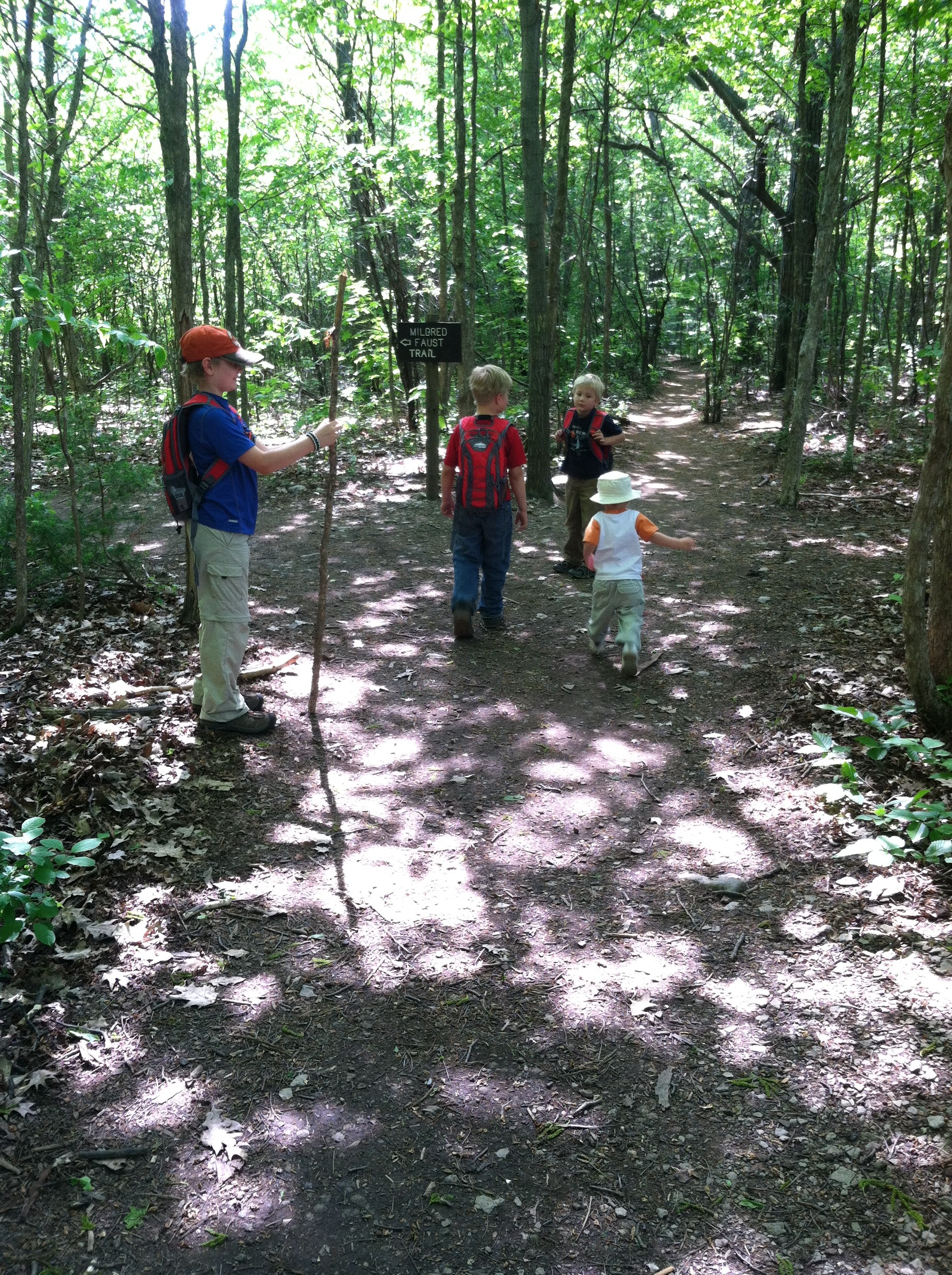
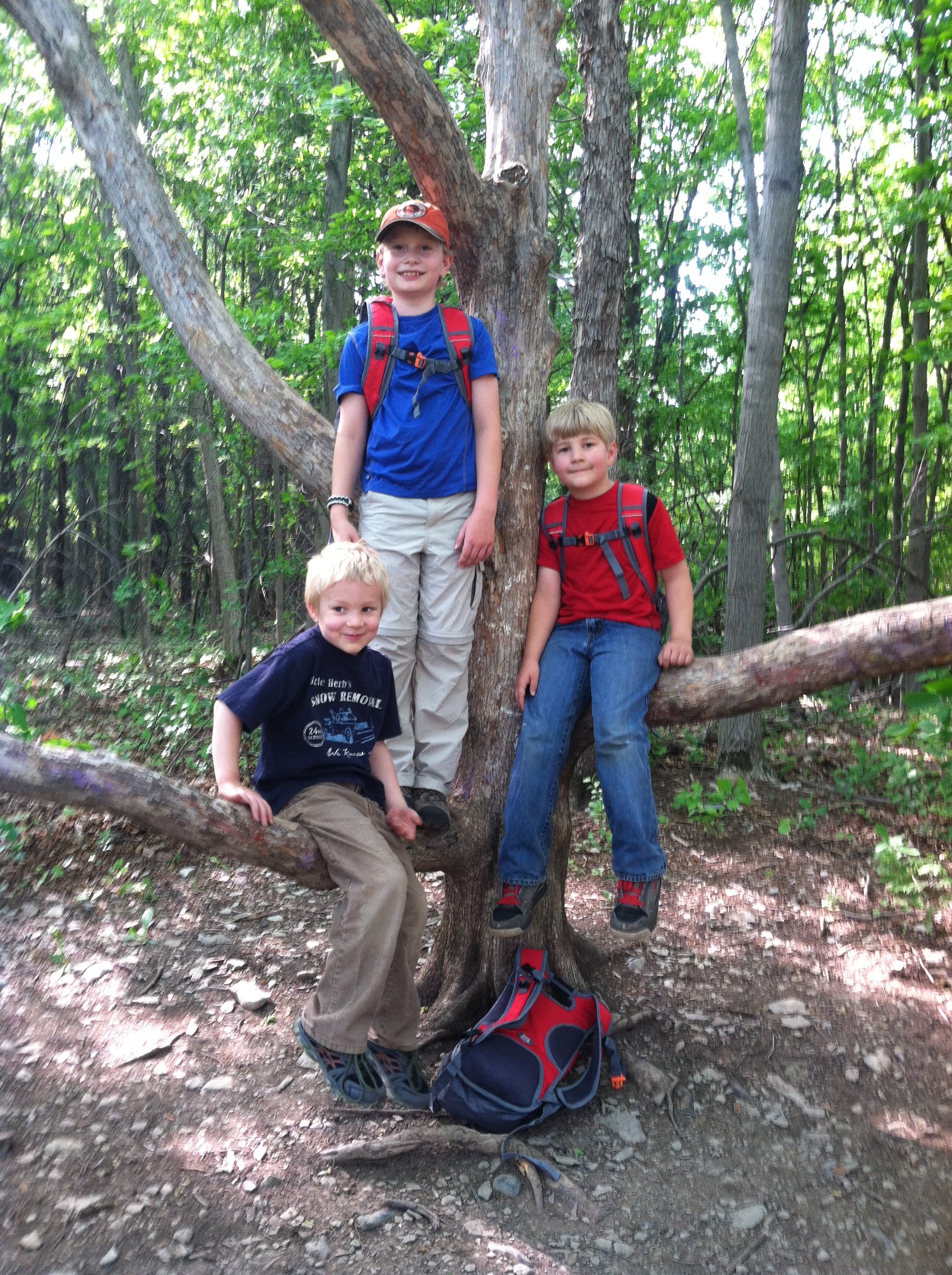
I say all this to encourage people to get their kids out hiking and enjoying outdoor activities as early as possible and to do it as a family. I had my older son sitting in my lap well kayaking before he could even walk (he had a life jacket on and I had a long daisy chain hooked from the top of my lifejacket to the bottom of his). He loved it. Children are much more capable than we think. You’ll never regret the time spent outside with your kids but you’ll always regret the time wasted on TV and video games. They will always cherish those memories as well. I still remember all the camping and fishing trips I took as a kid. Those are the memories I cherish most. Below are some pictures of us hiking on a well worn trail system on Memorial Day. What activities does your family like to do outside together? Do your kids like being outdoors? If your family is not use to hiking or being outdoors regularly, start small. A simple hike down a short trial will do wonders. Don’t try to start out with more than you or they can handle. Start small and enjoy working your way up to more difficult hikes, camping trips or backpacking trips. Enjoy the process together. You’ll also get to see some breathtaking views along the way.

Just an FYI, we have each of the older three kids carry their own hydration bag. This works out very well. They can easily carry their own water, snacks and lunch. We tried having them just carry containers with water in them but not too long down the trail they would get tired of carrying the containers so we found that this works our well for us. Also, with boys you will need snacks. Don’t venture out without some. If they are not eating they are thinking about eating! Our boys eat more than my wife and I do. Anyway, enjoy the time spent outdoors with your kids and don’t underestimate their abilities.


photo 1                                 photo 2

photo 3                                 photo 4

Homemade Mosquito and Tick Repellant

I love the wilderness dearly, but like most I get tired of getting eaten alive. I get bit even when no one else is being bitten! I’m always looking for natural bug repellants because I don’t like spraying pesticides on my body or clothing and especially not on my kids. My wife and I have tried many natural remedies and well some sort of work, none have worked for me. I’m special that way. The other week I came across a recipe for a natural tick and mosquito repellant that seems to work very well. I can’t remember where I got the recipe from or I would give the site credit. Good thing I wrote the recipe down! So I thought that I would share my findings.

Ingredients:

2 Cups of Distilled Vinegar
1 Cup of Water
20 Drops of Essential Oil

 
*Spray on skin, clothing and hair every 4 hours or as needed.

 
By adding essential oils you won’t smell like vinegar all day. We used peppermint essential oil because it is a natural repellant for ticks and mosquitoes. You can choose whatever essential oil that you would like but any type of mint or citrus essential oils would work great since they are natural repellants for ticks and mosquitoes. Mix everything together and place in a spray bottle or multiple pump spray bottles. So far this mixture works well for me and does better than any store bought spray. It is much more comforting to know that what I am spraying on my children and on me is not going to harm them or me. Try this recipe out and let me know how it works for you. What natural bug repellants do you use? How well do they work for you? Thanks for reading and please let me know if this helps you fend off the bugs this year.

Survival Food: Wild Game

Right now in New York we are in the midst of spring Turkey hunting season and walleye fishing season. I absolutely love this time of year. New life is springing forth and the air seems so fresh. The weather is consistently getting nicer and the warmth of the sun feels so wonderful and energizing. I find myself wishing I could spend every waking moment, this time of year, in the wilderness instead of keeping a regular work schedule.

Anyway the reason I’m bringing up the fact that we are in the midst of hunting and fishing season (in New York) is that this is the perfect time to learn skills for gathering wild game or to teach your young children how to catch wild game. When it comes to survival, knowing how to provide food for yourself and anyone with you could mean the difference between life and death.

Since the weather is nicer and generally warmer at this time of year it is easier on younger children to be out hunting now instead of in late fall (not very warm in New York usually by then). Teaching them how to hunt and fish well they are young will give them the time to fine tune their skills and will give them an appreciation for nature. Teach them to hunt or fish with the bare minimum instead of outfitting them with every gadget known to man. This will make them rely on skill instead of technology. Use homemade lures to catch fish. Try fishing with just a stick, some fishing line, a hook and a worm or homemade lure. This can be fun and challenging all at the same time. Adults should be practicing these skills as well. In a real survival situation you will most likely not have any professional fishing or hunting equipment. Now is the time to learn and practice these skills. Not when your life depends on it.

Test your skills when hunting. If you’re a bow hunter, try hunting with a recurve or long bow instead of a compound bow. If you already bow hunt with a recurve or long bow try making your own bow and hunting with that. For gun hunters, try bow hunting or get rid of the scope and use sights. If you have an area where you are able to, you can learn how to trap. No matter how skilled we are at hunting and fishing or trapping, we can all challenge ourselves more and fine tune our skills. The older I get the more I want to hunt or fish with gear that is as basic as possible. Someday if I get the chance I am going to make my own recurve bow and hunt with it.

The point of all this is to say that you need to practice the skill of catching wild game and this is the perfect time of year to do that. If you have children you can get them involved and have fun learning together. They will never forget the time you spend in the wilderness together and these skills may someday save their life or your own. I know many people that live off and provide for their families with the wild game they catch each year. My family included. We only eat wild fish and venison. We raise our own chickens and vegetables. You can save a lot of money by living off the land instead of relying on the grocery store to provide for your family but you need to gain the necessary skills first.

Enjoy this time of year and if you have children let them enjoy it with you. Make sure you obey all hunting and fishing laws in your area and don’t be reckless. Incorporate fishing with your camping trips. This way you’ll have some great tasting free food and your kids will taste the fruit of their labors. There’s nothing more satisfying than providing your own food well out backpacking and camping. Enjoy each moment and continue to learn and teach along the way.


(The picture is of my brother and the turkey he shot last weekend).

Hypothermia

At this time of year as the weather becomes warmer during the day people tend to get careless about staying dry as well as keeping their clothes from getting wet. The warmer weather feels great and it seems warmer than it is because we have become acclimated to the colder temperatures. This can make for a dangerous situation. In many areas during spring there can be huge temperature swings between day and night. You could have temperatures in the 80’s during the day and then they can dip below freezing at night. This could be a deadly combination if you find yourself wet and cold.

WIKIPEDIA Definition and Effects of Hypothermia

 
Hypothermia (from Greek ὑποθερμία) is a condition in which the body’s core temperature drops below that required for normal metabolism and body functions. This is generally considered to be 35.0 °C (95.0 °F). Body temperature is usually maintained near a constant level of 36.5–37.5 °C (97.7–99.5 °F) through biologic homeostasis or thermoregulation. If a person is exposed to cold, and their internal mechanisms cannot replenish the heat that is being lost, the body’s core temperature falls, and characteristic symptoms occur such as shivering and mental confusion.
One of the lowest documented body temperatures from which anyone has recovered was 13.0 °C (55.4 °F) in a near-drowning incident involving a 7-year-old girl in Sweden in December 2010.[1] Hypothermia is the opposite of hyperthermia which is present in heat exhaustion and heat stroke.


Mild

 
Symptoms of mild hypothermia may be vague, with sympathetic nervous system excitation (shivering, hypertension, tachycardia, tachypnea, and vasoconstriction). These are all physiological responses to preserve heat. Cold diuresis, mental confusion, and hepatic dysfunction may also be present. Hyperglycemia may be present, as glucose consumption by cells and insulin secretion both decrease, and tissue sensitivity to insulin may be blunted. Sympathetic activation also releases glucose from the liver. In many cases, however, especially in alcoholic patients, hypoglycemia appears to be a more common presentation. Hypoglycemia is also found in many hypothermic patients, because hypothermia may be a result of hypoglycemia.


Moderate

 
Low body temperature results in shivering becoming more violent. Muscle mis-coordination becomes apparent. Movements are slow and labored, accompanied by a stumbling pace and mild confusion, although the person may appear alert. Surface blood vessels contract further as the body focuses its remaining resources on keeping the vital organs warm. The subject becomes pale. Lips, ears, fingers and toes may become blue.


Severe

 
As the temperature decreases, further physiological systems falter and heart rate, respiratory rate, and blood pressure all decrease. This results in an expected heart rate in the 30s at a temperature of 28 °C (82 °F).
Difficulty in speaking, sluggish thinking, and amnesia start to appear; inability to use hands and stumbling is also usually present. Cellular metabolic processes shut down. Below 30 °C (86 °F), the exposed skin becomes blue and puffy, muscle coordination becomes very poor, walking becomes almost impossible, and the person exhibits incoherent/irrational behavior including terminal burrowing (see below) or even a stupor. Pulse and respiration rates decrease significantly, but fast heart rates (ventricular tachycardia, atrial fibrillation) can occur. Major organs fail. Clinical death occurs.


Paradoxical undressing

 
Twenty to fifty percent of hypothermia deaths are associated with paradoxical undressing. This typically occurs during moderate to severe hypothermia, as the person becomes disoriented, confused, and combative. They may begin discarding their clothing, which, in turn, increases the rate of heat loss.

 
Rescuers who are trained in mountain survival techniques are taught to expect this; however, some may assume incorrectly that urban victims of hypothermia have been subjected to a sexual assault.

 
One explanation for the effect is a cold-induced malfunction of the hypothalamus, the part of the brain that regulates body temperature. Another explanation is that the muscles contracting peripheral blood vessels become exhausted (known as a loss of vasomotor tone) and relax, leading to a sudden surge of blood (and heat) to the extremities, fooling the person into feeling overheated.


Terminal burrowing

 
An apparent self-protective behavior known as terminal burrowing, or hide-and-die syndrome, occurs in the final stages of hypothermia. The afflicted will enter small, enclosed spaces, such as underneath beds or behind wardrobes. It is often associated with paradoxical undressing. Researchers in Germany claim this is “obviously an autonomous process of the brain stem, which is triggered in the final state of hypothermia and produces a primitive and burrowing-like behavior of protection, as seen in hibernating animals.”This happens mostly in cases where temperature drops slowly.


It is important to dress in layers just like you would during the winter months. As you become warm remove a layer at a time until you are not perspiring. Try to keep your clothing as dry as possible. If you find yourself crossing a river or stream, try to cross at a shallow point or carry clothing across if possible. If clothing becomes wet either because of the environment or because of perspiration, try to get the wet clothing dry before dark when temperatures start to drop. Dry clothes over a fire or try to get them dry by laying them on large warm rocks in the sunlight of the day. Whatever you must do to get dry and warm before dark do it.

 
It is important to carry rain gear and a good waterproof shelter at this time of year as well. A day of hiking in a cold drenching rain can sap you of energy and drop your core temperature quickly once you stop moving. The last thing you want to do is to have a poor shelter that is not waterproof and find yourself in a freezing rain storm in the middle of the night. It’s all about being smart and preparing ahead of time. Be prepared for the changes of temperature and weather that go along with this time of year. The better you are prepared, the better the chance that you will enjoy your trip and return safely. Be wise about the clothing you are wearing and the materials they are made out of. Know and learn the limitations of all your gear. Enjoy your spring hiking and camping! Take in the fresh air and new life that is coming forth. This is such a wonderful time of year to be out on the trail enjoying nature. What special gear is a must have for you at this time of year? What special trip do you have planned for this spring? (Please share photos of your trip)